Indiana Permit Practice Test 8 (2026)
20 questions. Tap an answer to check it.
From the official handbook, Published July 2026, Sections 6, 7, 8 · Checked Oct 2026 · Not affiliated with the BMV. Indiana Driver's Manual
Question 1 of 20
When should you start crossing railroad tracks?
Show answer and explanation
Answer: Only when you can clear the tracks without stopping
Never stop or shift gears on the tracks.
Report a problem
Question 2 of 20
A collision can't be avoided. What is better to hit?
Show answer and explanation
Answer: Something that will give way, like brush or shrubs
Choose something soft over something hard, and avoid a head-on crash.
Report a problem
Question 3 of 20
During a traffic stop, where should the driver keep their hands?
Show answer and explanation
Answer: On the steering wheel
Keep hands visible; tell the officer before reaching for documents.
Report a problem
Question 4 of 20
Can you use hand signals on the Indiana driving skills exam?
Show answer and explanation
Answer: No
Hand signals are allowed when lights fail, but not on a skills exam.
Report a problem
Question 5 of 20
A train has just passed at a crossing with two tracks. What should you check before crossing?
Show answer and explanation
Answer: That another train is not coming on the other track
A second train may be hidden behind the first one.
Report a problem
Question 6 of 20
What does signing a traffic ticket mean?
Show answer and explanation
Answer: You acknowledge receiving it
Signing is not an admission of guilt; you can contest it in traffic court.
Report a problem
Question 7 of 20
You must use low beams when following another vehicle within how many feet?
Show answer and explanation
Report a problem
Question 8 of 20
On a loose gravel road, what should you do before turns and stops?
Show answer and explanation
Answer: Slow down earlier
Traction is reduced on gravel; slow down sooner to avoid skidding.
Report a problem
Question 9 of 20
How far should the driver sit from the steering wheel?
Show answer and explanation
Answer: At least 12 inches
Sitting at least 12 inches away protects you from the air bag.
Report a problem
Question 10 of 20
Approaching the crest of a steep hill on a rural road, what should you do?
Show answer and explanation
Answer: Slow down, move to the right and watch for oncoming vehicles
Never pass near a crest; you can't see what's coming.
Report a problem
Question 11 of 20
When must you give a proper turn signal?
Show answer and explanation
Answer: Before turning or changing lanes
A proper signal is required before turning or changing lanes.
Report a problem
Question 12 of 20
How should you avoid the glare of oncoming headlights at night?
Show answer and explanation
Answer: Look toward the right side of the road
Don't look into the lights; focus on the right side of the road.
Report a problem
Question 13 of 20
Do you need a seat belt if your car has air bags?
Show answer and explanation
Answer: Yes; air bags work together with seat belts
Without a belt the air bag itself can injure you.
Report a problem
Question 14 of 20
How should you adjust your speed at night?
Show answer and explanation
Answer: Reduce your normal speed, especially on unfamiliar roads
Pedestrians, markings and vehicles are harder to see at night.
Report a problem
Question 15 of 20
What does this sign mean?
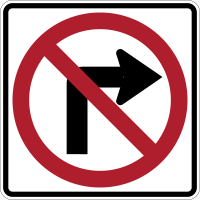
Show answer and explanation
Report a problem
Question 16 of 20
Where should a head restraint be positioned?
Show answer and explanation
Answer: Higher than the top of the head and close to it
Head restraints go above the top of the head and as close as possible to the back of it.
Report a problem
Question 17 of 20
A police car signals you to pull over. What should you do first?
Show answer and explanation
Answer: Turn on your right turn signal to acknowledge the officer
The right signal shows you see the officer; then move to the right shoulder.
Report a problem
Question 18 of 20
What does this sign mean?
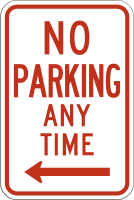
Show answer and explanation
Report a problem
Question 19 of 20
When should you check tire pressure?
Show answer and explanation
Answer: When the tires are cold: before driving or at least three hours after
Check tires cold for an accurate reading.
Report a problem
Question 20 of 20
During a traffic stop, where should you be unless the officer tells you otherwise?
Show answer and explanation
Answer: Inside your vehicle
In most cases the safest place is inside the vehicle, hands in view.
Report a problem
Your score
0%0 / 20
Review the explanations of the questions you missed.
More practice tests
Full exam and road signs
Practice tests
- Practice Test 120 questions
- Practice Test 220 questions
- Practice Test 320 questions
- Practice Test 420 questions
- Practice Test 520 questions
- Practice Test 620 questions
- Practice Test 720 questions
- Practice Test 920 questions
- Practice Test 1020 questions
- Practice Test 1120 questions
- Practice Test 1220 questions
Tests by topic
- Alcohol and Drugs13 questions
- Traffic Signals and Signs20 questions
- Right-of-Way Rules15 questions
- Getting Your License20 questions
- Your Car, Signals and Headlights13 questions
- Lanes, Turns and Passing17 questions
- Parking Rules13 questions
- Sharing the Road20 questions
- Speed Limits and Other Laws14 questions
- Safe Driving16 questions
- Weather, Breakdowns and Emergencies20 questions
- Insurance and Collisions17 questions