Indiana Permit Practice Test 7 (2026)
20 questions. Tap an answer to check it.
From the official handbook, Published July 2026, Sections 6, 7, 8 · Checked Oct 2026 · Not affiliated with the BMV. Indiana Driver's Manual
Question 1 of 20
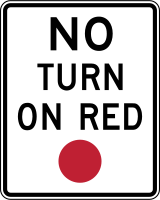
What does this white sign mean?
Show answer and explanation
Answer: You may not turn while the light is red
No Turn on Red is a white regulation sign.
Report a problem
Question 2 of 20
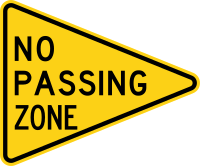
Where is this pennant-shaped sign posted and what does it mean?
Show answer and explanation
Answer: On the left side of two-way roads; do not pass
The pennant marks the start of a no-passing zone.
Report a problem
Question 3 of 20
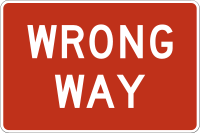
What should you do if you see this sign?
Show answer and explanation
Answer: You are going the wrong way; turn around safely
Wrong Way is a red sign that requires immediate action.
Report a problem
Question 4 of 20
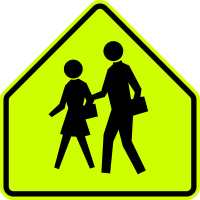
What does this five-sided sign warn you about?
Show answer and explanation
Answer: A school area where children may be crossing
Five-sided signs mark areas near schools.
Report a problem
Question 5 of 20
What does this sign mean?
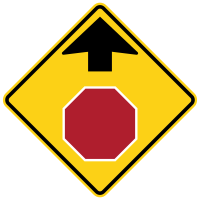
Show answer and explanation
Answer: Stop sign ahead
It warns of a stop sign ahead so you can slow down in time.
Report a problem
Question 6 of 20
What does this crossbuck mark?
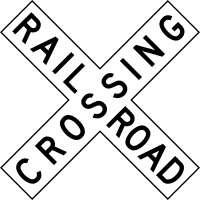
Show answer and explanation
Answer: The location of the railroad tracks
Crossbucks mark where the tracks are.
Report a problem
Question 7 of 20
How should you treat this railroad crossbuck when it is displayed alone?
Show answer and explanation
Answer: As a yield sign; stop if a train is coming
Alone, a crossbuck works like a yield sign.
Report a problem
Question 8 of 20
A vehicle displaying this emblem cannot go faster than what speed?
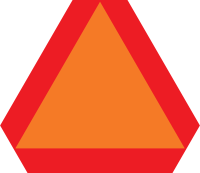
Show answer and explanation
Answer: 25 mph
The slow-moving vehicle emblem marks vehicles that cannot exceed 25 mph.
Report a problem
Question 9 of 20
Your car breaks down on the shoulder. Where should you place a red reflective triangle?
Show answer and explanation
Answer: 200 feet behind the car (500 feet on a hill or curve)
Place it far enough back to warn drivers in time.
Report a problem
Question 10 of 20
If you must get out of your car on a roadside shoulder, which side should you exit from?
Show answer and explanation
Answer: The passenger side, after checking around you
Getting out on the passenger side keeps you away from passing traffic.
Report a problem
Question 11 of 20
Your car is stuck on the tracks and a train is coming. Which way should you run?
Show answer and explanation
Answer: Away from the tracks at a 45-degree angle toward the oncoming train
Running toward the train at an angle keeps you clear of flying debris.
Report a problem
Question 12 of 20
Your car stalls on the tracks and no train is coming. Whom should you call first?
Show answer and explanation
Answer: The number on the blue Emergency Notification sign at the crossing
Call the railroad's ENS number on the blue sign, then 911.
Report a problem
Question 13 of 20
Your car plunges into water. How should you get out?
Show answer and explanation
Answer: Through an open window, not the door
Water pressure makes doors nearly impossible to open; unbuckle, open a window and get out.
Report a problem
Question 14 of 20
Once railroad crossing lights start flashing and the gate begins to lower, about how long do you have to get off the crossing?
Show answer and explanation
Answer: About 20 seconds
If stuck, get everyone out and away from the tracks.
Report a problem
Question 15 of 20
Your regular brakes suddenly fail. What should you try?
Show answer and explanation
Answer: Shift to a lower gear and pump the brake pedal fast and hard
Pumping may build enough pressure; the parking brake can help if used carefully.
Report a problem
Question 16 of 20
In an emergency, why should you never turn the ignition to LOCK while moving?
Show answer and explanation
Answer: The steering will lock and you will lose control
With a steering wheel lock, turning the key to lock while moving locks the steering.
Report a problem
Question 17 of 20
A lane is closed ahead in a work zone. When should you usually merge?
Show answer and explanation
Answer: Early, as soon as you see the signs
Merging early keeps traffic flowing, unless signs ask for a late or zipper merge.
Report a problem
Question 18 of 20
How can you detect carbon monoxide in your car?
Show answer and explanation
Answer: You can't see, smell or taste it
Watch for symptoms like drowsiness, dizziness and headache, and have the exhaust checked.
Report a problem
Question 19 of 20
The driver ahead signals a turn and slows down. What should you do?
Show answer and explanation
Answer: Slow down and be prepared to stop
Follow turning vehicles with caution and be ready to stop.
Report a problem
Question 20 of 20
Is it legal to drive around a railroad crossing gate that is down?
Show answer and explanation
Report a problem
Your score
0%0 / 20
Review the explanations of the questions you missed.
More practice tests
Full exam and road signs
Practice tests
- Practice Test 120 questions
- Practice Test 220 questions
- Practice Test 320 questions
- Practice Test 420 questions
- Practice Test 520 questions
- Practice Test 620 questions
- Practice Test 820 questions
- Practice Test 920 questions
- Practice Test 1020 questions
- Practice Test 1120 questions
- Practice Test 1220 questions
Tests by topic
- Alcohol and Drugs13 questions
- Traffic Signals and Signs20 questions
- Right-of-Way Rules15 questions
- Getting Your License20 questions
- Your Car, Signals and Headlights13 questions
- Lanes, Turns and Passing17 questions
- Parking Rules13 questions
- Sharing the Road20 questions
- Speed Limits and Other Laws14 questions
- Safe Driving16 questions
- Weather, Breakdowns and Emergencies20 questions
- Insurance and Collisions17 questions