California DMV Permit Mock Exam (2026)
46 questions mixed from every topic of the handbook. Use it as a final check before your knowledge test.
From the official handbook, DL 600 (REV. 6/2025), Sections 2, 5, 6, 7, 8, 9, 10 · Checked Oct 2026 · Not affiliated with the DMV. California Driver's Handbook
Question 1 of 46
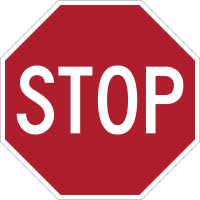
What must you do at this sign?
Show answer and explanation
Answer: Make a full stop before the crosswalk or limit line, then go when it is safe
A STOP sign always requires a full stop: before the crosswalk or limit line, or before the intersection if there is neither. Check traffic in all directions before you go.
Report a problem
Question 2 of 46
Who may park at a blue painted curb?
Show answer and explanation
Answer: A disabled person, or someone driving a disabled person, with a special placard or license plate
Blue curbs are for disabled persons (or someone driving them) displaying a disabled placard or special license plate.
Report a problem
Question 3 of 46
A provisional driver must drive during restricted hours because of a medical need. What must they carry?
Show answer and explanation
Answer: A note signed by their physician
The medical exception requires a note signed by a physician that states the condition and the expected recovery date.
Report a problem
Question 4 of 46
Where is a U-turn never allowed?
Show answer and explanation
Answer: In front of a fire station
Never make a U-turn in front of a fire station or use its driveway to turn around.
Report a problem
Question 5 of 46
When may you drive through a safety zone marked for pedestrians waiting for a bus or streetcar?
Show answer and explanation
Answer: Never, under any condition
Safety zones are for waiting pedestrians. Do not drive through them under any condition.
Report a problem
Question 6 of 46
While waiting to turn left, how should your front wheels be pointed?
Show answer and explanation
Answer: Straight ahead until it is safe to start the turn
If your wheels are turned left and a vehicle hits you from behind, you could be pushed into oncoming traffic.
Report a problem
Question 7 of 46
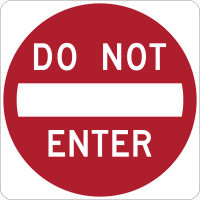
What does this sign mean?
Show answer and explanation
Answer: Do not enter the road or ramp where the sign is posted
This red and white regulatory sign tells you not to drive into the road or ramp where it is posted.
Report a problem
Question 8 of 46
Is it legal in California for a motorcycle to ride between lanes of traffic (lane splitting)?
Show answer and explanation
Answer: Yes, it is legal to share lanes with motorcycles
Lane splitting is legal in California. Give motorcycles room and check for them before changing lanes.
Report a problem
Question 9 of 46
Two vehicles meet on a steep, narrow mountain road where neither can pass. Who has the right-of-way?
Show answer and explanation
Answer: The vehicle facing uphill
The vehicle facing uphill has the right-of-way. The downhill vehicle has more control backing up the hill, so it backs up until the other can pass.
Report a problem
Question 10 of 46
When you are in the proper lane to exit a highway, how early should you signal?
Show answer and explanation
Answer: About five seconds (approximately 400 feet) before the exit
Signal about five seconds, roughly 400 feet, before you exit, and do not cross solid lines.
Report a problem
Question 11 of 46
Your car does not have ABS and begins to skid. How should you brake?
Show answer and explanation
Answer: Quickly pump the brakes until you reach a safe speed
Without ABS, pump the brakes quickly until you are at a safe speed.
Report a problem
Question 12 of 46
How close to a crosswalk (without a curb extension) may you park?
Show answer and explanation
Answer: No closer than 20 feet
Do not park within 20 feet of a marked or unmarked crosswalk (15 feet where there is a curb extension).
Report a problem
Question 13 of 46
What does California's Basic Speed Law say?
Show answer and explanation
Answer: Never drive faster than is safe for current conditions, regardless of the posted limit
Your speed must depend on traffic, road surface, weather, and people on the road, even if that means going below the posted limit.
Report a problem
Question 14 of 46
Which medicines can make it illegal for you to drive?
Show answer and explanation
Answer: Any prescription or over-the-counter medicine that affects your ability to drive
California's DUI law covers any drug that affects your driving, including prescriptions and over-the-counter medicines. Read the label before you drive.
Report a problem
Question 15 of 46
A truck ahead moves to the left before turning right. Why?
Show answer and explanation
Answer: Large vehicles must often swing wide to complete a turn
A truck's rear wheels follow a shorter path than the front wheels, so it swings wide. Check its turn signals before you pass.
Report a problem
Question 16 of 46
A flashing yellow arrow for a left turn means:
Show answer and explanation
Answer: You may turn left, but you must first yield to oncoming traffic
With a flashing yellow arrow you can turn, but the turn is not protected: yield to oncoming traffic first.
Report a problem
Question 17 of 46
How many hours of supervised driving practice must a driver under 18 complete before the drive test?
Show answer and explanation
Answer: At least 50 hours
Minors need at least 50 hours of practice with a licensed driver 25 or older, and ten of those hours must be at night.
Report a problem
Question 18 of 46
On a two-way road with one lane in each direction, when may you pass on the right?
Show answer and explanation
Answer: When the driver ahead is turning left and you can pass safely on the right
You may pass on the right when the driver ahead is turning left and it is safe, on open highways with two or more lanes in your direction, or on one-way streets.
Report a problem
Question 19 of 46
What is the speed limit in an alley?
Show answer and explanation
Report a problem
Question 20 of 46
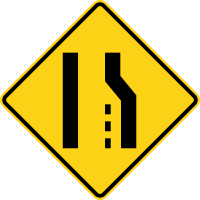
What does this warning sign mean?
Show answer and explanation
Answer: The right lane ends ahead: merge left when it is safe
The Lane Ends sign warns that one lane is ending. If you are in it, signal and move into the next lane when it is safe.
Report a problem
Question 21 of 46
Your car starts to skid on a slippery road. What should you do?
Show answer and explanation
Answer: Ease off the accelerator, do not brake, and steer in the direction of the skid
Slowly remove your foot from the accelerator, do not use the brakes, turn the wheel in the direction of the skid, and try to get a wheel onto dry pavement.
Report a problem
Question 22 of 46
Before changing lanes on a freeway, you should signal for at least:
Show answer and explanation
Answer: Five seconds
On a freeway, signal at least five seconds before you change lanes.
Report a problem
Question 23 of 46
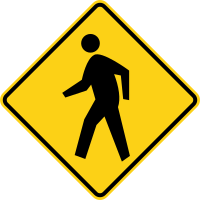
You see this sign. What should you expect?
Show answer and explanation
Answer: People crossing the road ahead
This sign warns of a pedestrian crossing ahead. Slow down and be ready to stop: pedestrians have the right-of-way.
Report a problem
Question 24 of 46
How far should you sit from the steering wheel airbag cover?
Show answer and explanation
Answer: At least 10 inches
Sit at least 10 inches from the airbag, measured from the center of the steering wheel to your breastbone. Passengers should do the same.
Report a problem
Question 25 of 46
The open-container rule does NOT apply if you are a passenger in:
Show answer and explanation
Answer: A bus, taxi, camper, or motorhome
The handbook lists the exceptions: passengers in a bus, taxi, camper, or motorhome.
Report a problem
Question 26 of 46
To merge into traffic on a highway, you need a gap of about:
Show answer and explanation
Answer: A full block, about 300 feet
On the highway you need about a full block (300 feet) of space; on city streets, about half a block (150 feet).
Report a problem
Question 27 of 46
How close to a fire hydrant may you park?
Show answer and explanation
Answer: No closer than 15 feet
Never park within 15 feet of a fire hydrant or a fire station driveway.
Report a problem
Question 28 of 46
You may not pass within how many feet of an intersection, bridge, tunnel, or railroad crossing?
Show answer and explanation
Answer: 100 feet
Do not pass within 100 feet of an intersection, bridge, tunnel, railroad crossing, or other hazardous area.
Report a problem
Question 29 of 46
Your load extends more than 4 feet beyond your rear bumper. What must you display during the day?
Show answer and explanation
Answer: A 12-inch red or fluorescent orange square flag
Cargo extending more than 4 feet past the rear bumper needs a 12-inch red or fluorescent orange flag; at night, two red lights.
Report a problem
Question 30 of 46
A blind pedestrian pulls in their cane and steps away from the intersection. This usually means:
Show answer and explanation
Answer: You may go
Pulling in the cane and stepping back is a signal that you may proceed.
Report a problem
Question 31 of 46
How much should you reduce your speed on packed snow?
Show answer and explanation
Report a problem
Question 32 of 46
When must you have your headlights on in the evening?
Show answer and explanation
Answer: Beginning 30 minutes after sunset
Headlights are required from 30 minutes after sunset until 30 minutes before sunrise, and whenever it is too dark to see 1,000 feet ahead.
Report a problem
Question 33 of 46
You are driving behind a large truck and cannot see its side mirrors. This means:
Show answer and explanation
Answer: The truck driver cannot see you
If you cannot see the truck's side mirrors, you are in its blind spot (No Zone) and the driver cannot see you.
Report a problem
Question 34 of 46
You are in a collision and do not have proper insurance. What can happen, even if you were not at fault?
Show answer and explanation
Answer: Your driving privilege can be suspended for up to four years
Without proper insurance, your driving privilege can be suspended for up to four years, no matter who caused the collision.
Report a problem
Question 35 of 46
When may a driver under 18 use a cell phone while driving?
Show answer and explanation
Answer: Only to call for emergency assistance
Minors may not use a cell phone or wireless device while driving, even hands-free, except to call for emergency help.
Report a problem
Question 36 of 46
By driving in California, you have agreed to:
Show answer and explanation
Answer: Take a breath, blood, or urine test if an officer suspects you of DUI
This is California's implied consent rule: driving in the state means you consent to chemical testing when an officer suspects DUI.
Report a problem
Question 37 of 46
Unless otherwise posted, the speed limit in business or residential districts is:
Show answer and explanation
Answer: 25 mph
In business and residential districts the limit is 25 mph unless a sign says otherwise.
Report a problem
Question 38 of 46
California's minimum liability insurance must cover at least how much for a single death or injury?
Show answer and explanation
Answer: $30,000
Minimum coverage: $30,000 for one person's death or injury, $60,000 for more than one person, and $15,000 for property damage.
Report a problem
Question 39 of 46
You see a collision ahead. Besides turning on your emergency flashers, how can you warn drivers behind you?
Show answer and explanation
Answer: Lightly tap your brake pedal three or four times
Tapping the brake pedal three or four times flashes your brake lights and warns the drivers behind you.
Report a problem
Question 40 of 46
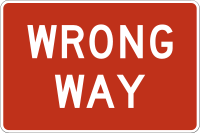
You just turned onto a road and see this sign. What should you do?
Show answer and explanation
Answer: When it is safe, back out or turn around
WRONG WAY (often posted with DO NOT ENTER) means you are driving against traffic. Get out as soon as it is safe: back out or turn around.
Report a problem
Question 41 of 46
If an officer asks you to take a blood or urine test because they think you are under the influence and you refuse:
Show answer and explanation
Answer: DMV will suspend or revoke your driving privilege for one year
Refusing the test has its own penalty: DMV suspends or revokes your driving privilege for one year.
Report a problem
Question 42 of 46
A round yellow-and-black sign or an X-shaped sign warns that you are approaching:
Show answer and explanation
Answer: A railroad crossing
These signs mark a railroad crossing: look, listen, slow down, and be ready to stop for any train.
Report a problem
Question 43 of 46
If you are under 18, how long must you have your instruction permit before you can schedule the behind-the-wheel test?
Show answer and explanation
Answer: 6 months
Minors must hold a permit for at least 6 months (or turn 18) before scheduling the drive test.
Report a problem
Question 44 of 46
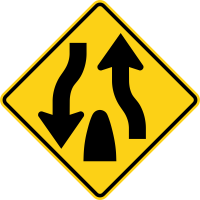
What does this sign mean?
Show answer and explanation
Answer: The divided highway ends: traffic in both directions will no longer be separated
The End Divided Highway sign warns that the median ends ahead. After it, oncoming traffic is separated from you only by a line.
Report a problem
Question 45 of 46
A sign shows a picture inside a red circle with a red line through it. What does it mean?
Show answer and explanation
Answer: The action shown in the picture is not allowed
The picture inside the circle shows what you cannot do, and it may also be explained with words.
Report a problem
Question 46 of 46
At a railroad crossing, the gate rises but the red lights are still flashing. What should you do?
Show answer and explanation
Answer: Stay stopped until the red lights stop flashing
Do not cross until the red lights stop flashing, even if the gate rises. Another train may be coming.
Report a problem
Your score
0%0 / 46
Review the explanations of the questions you missed.
Next test: Alcohol and Drugs →
More practice tests
Full exam and road signs
Practice tests
Tests by topic
- Alcohol and Drugs20 questions
- Traffic Signals and Signs10 questions
- Right-of-Way Rules13 questions
- Getting Your License14 questions
- Signals, Horn and Headlights15 questions
- Lanes, Turns and Passing20 questions
- Parking and Curb Colors15 questions
- Sharing the Road20 questions
- Speed Limits and Other Laws20 questions
- Safe Driving14 questions
- Weather and Emergencies14 questions
- Insurance and Collisions10 questions