California Permit Practice Test 3 (2026)
20 questions. Tap an answer to check it.
From the official handbook, DL 600 (REV. 6/2025), Sections 5, 6, 7, 9 · Checked Oct 2026 · Not affiliated with the DMV. California Driver's Handbook
Question 1 of 20
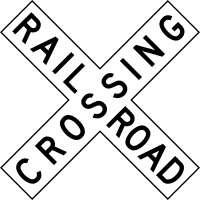
What does this sign mark?
Show answer and explanation
Answer: A railroad crossing: let any train pass before you cross
The X-shaped sign marks a railroad crossing. Let any trains pass before you proceed.
Report a problem
Question 2 of 20
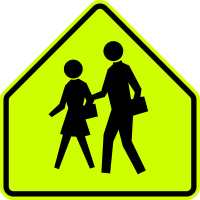
What should you do when you see this sign?
Show answer and explanation
Answer: Drive slowly and stop for children in the crosswalk
The 5-sided sign means you are near a school. Drive slowly and stop for children in the crosswalk.
Report a problem
Question 3 of 20
Which lane is called the Number 1 Lane?
Show answer and explanation
Answer: The left (fast) lane
Lanes are numbered from the left: the left (fast) lane is the Number 1 Lane, the next one to the right is the Number 2 Lane, and so on.
Report a problem
Question 4 of 20
Before changing lanes, after signaling and checking your mirrors, you should also:
Show answer and explanation
Answer: Look over your shoulder in the direction you plan to move
Mirrors do not show everything. Look over your shoulder toward the lane you are moving into and check your blind spots. You do not need to slow down to change lanes.
Report a problem
Question 5 of 20
You are next to double solid white lines, such as at a carpool lane. You may:
Show answer and explanation
Answer: Never change lanes over them; wait for a single broken white line
Never change lanes over double solid white lines. Wait until you see a single broken white line.
Report a problem
Question 6 of 20
A row of solid white triangles across your lane is a yield line. It shows:
Show answer and explanation
Answer: Where you must yield or stop
The yield line shows approaching vehicles where to yield or stop. The triangles point toward the approaching vehicles.
Report a problem
Question 7 of 20
You see a collision ahead. Besides turning on your emergency flashers, how can you warn drivers behind you?
Show answer and explanation
Answer: Lightly tap your brake pedal three or four times
Tapping the brake pedal three or four times flashes your brake lights and warns the drivers behind you.
Report a problem
Question 8 of 20
Two sets of double solid yellow lines two or more feet apart mean:
Show answer and explanation
Answer: It is a barrier: do not drive over it, turn left, or make a U-turn across it
Two sets of double yellow lines two or more feet apart are a barrier. Cross only at designated openings.
Report a problem
Question 9 of 20
Your car breaks down and you cannot get completely off the road. Where should you avoid stopping?
Show answer and explanation
Answer: Just over a hill or just around a curve
Other drivers may not see your car in time if you stop just over a hill or just around a curve.
Report a problem
Question 10 of 20
A broken yellow line next to your lane means:
Show answer and explanation
Answer: You may pass when it is safe
If the broken yellow line is on your side, you may pass, but only when it is safe.
Report a problem
Question 11 of 20
A single solid yellow line marks:
Show answer and explanation
Answer: The center of a road with two-way traffic
A single solid yellow line marks the center of a two-way road. Do not pass if there is only one lane in your direction and the solid line is on your side.
Report a problem
Question 12 of 20
When may you cross a single set of double solid yellow lines?
Show answer and explanation
Answer: To turn left into or out of a driveway or private road, or to make a U-turn
Stay to the right of double yellow lines, but you may turn left across them to enter or leave a driveway or private road, or to make a U-turn.
Report a problem
Question 13 of 20
In the handbook's BAC chart, one drink is equal to:
Show answer and explanation
Answer: 12 oz. of 5% beer
One drink is 12 oz. of 5% beer, 5 oz. of 12% wine, or 1.5 oz. of 80-proof liquor.
Report a problem
Question 14 of 20
You are about to turn and see no other vehicles around. Should you signal?
Show answer and explanation
Answer: Yes, signal even when you do not see other vehicles
Always signal, even when the road looks empty: you may not see a pedestrian, bicyclist, or vehicle.
Report a problem
Question 15 of 20
You are 15 and are convicted of riding a bicycle under the influence of alcohol. What can happen to your future driving privilege?
Show answer and explanation
Answer: It may be suspended or delayed for one year once you are eligible to drive
If you are 13 to 20 and convicted of cycling under the influence, your driving privilege may be suspended or delayed for one year once you become eligible.
Report a problem
Question 16 of 20
Before changing lanes on a freeway, you should signal for at least:
Show answer and explanation
Answer: Five seconds
On a freeway, signal at least five seconds before you change lanes.
Report a problem
Question 17 of 20
You must dim your high beams when an oncoming vehicle is within:
Show answer and explanation
Answer: 500 feet
Switch to low beams within 500 feet of an oncoming vehicle so you do not blind the other driver.
Report a problem
Question 18 of 20
You miss the street where you wanted to turn. What should you do?
Show answer and explanation
Answer: Keep driving until you can safely and legally turn around
Last-minute changes cause collisions. If you miss a turn, continue until you can turn around safely and legally.
Report a problem
Question 19 of 20
On a narrow mountain road, when should you use your horn?
Show answer and explanation
Answer: When you cannot see at least 200 feet ahead, to alert oncoming traffic
Use the horn to warn oncoming traffic on narrow mountain roads where you cannot see at least 200 feet ahead.
Report a problem
Question 20 of 20
If you are under 21, you may carry alcohol in a vehicle only when:
Show answer and explanation
Answer: Someone 21 or older is with you and the container is full, sealed, and unopened
Drivers under 21 may not carry alcohol unless a person 21 or older is with them, and the container must be full, sealed, and unopened (there is a separate exception for work with an off-site liquor sales license).
Report a problem
Your score
0%0 / 20
Review the explanations of the questions you missed.
More practice tests
Full exam and road signs
Practice tests
Tests by topic
- Alcohol and Drugs20 questions
- Traffic Signals and Signs10 questions
- Right-of-Way Rules13 questions
- Getting Your License14 questions
- Signals, Horn and Headlights15 questions
- Lanes, Turns and Passing20 questions
- Parking and Curb Colors15 questions
- Sharing the Road20 questions
- Speed Limits and Other Laws20 questions
- Safe Driving14 questions
- Weather and Emergencies14 questions
- Insurance and Collisions10 questions