Texas Permit Practice Test 4 (2026)
20 questions. Tap an answer to check it.
From the official handbook, Revised January 2026, Sections 2, 5, 6, 7, 9 · Checked Oct 2026 · Not affiliated with the DPS. Texas Driver Handbook (DL-7)
Question 1 of 20
What is the minimum tire tread depth required in Texas?
Show answer and explanation
Answer: 2/32 of an inch
Tires must be in safe condition with at least 2/32 of an inch of tread.
Report a problem
Question 2 of 20
If you must stop on a highway outside a city and cannot get off the road, from how far must your vehicle be visible?
Show answer and explanation
Answer: At least 200 feet in each direction
Leave room for others to pass, make sure the vehicle is visible for 200 feet each way and, at night, use parking lights or dim headlights.
Report a problem
Question 3 of 20
How often must a vehicle registered in Texas be inspected?
Show answer and explanation
Answer: Every year
Every vehicle registered in Texas, including motorcycles and mopeds, must pass inspection each year at an official station.
Report a problem
Question 4 of 20
What is double parking, which is illegal?
Show answer and explanation
Answer: Stopping on the road side of a vehicle already parked at the curb
You may not stop, stand or park on the road side of a vehicle stopped or parked at the curb.
Report a problem
Question 5 of 20
When passing on a two-lane road, you must be back in the right lane before an oncoming car comes within how many feet?
Show answer and explanation
Answer: 200 feet
Make sure you have time and space to pass and return to the right lane before an oncoming car is within 200 feet.
Report a problem
Question 6 of 20
Your foot brake must be able to stop the car within what distance from 20 mph?
Show answer and explanation
Answer: 25 feet
Required equipment: the foot brake must stop the car within 25 feet at 20 mph.
Report a problem
Question 7 of 20
What does this sign mean?
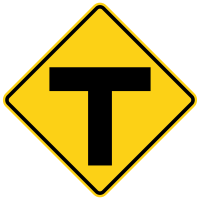
Show answer and explanation
Answer: The road ends ahead: you must turn left or right
At a T intersection you must turn left or right; be prepared to yield.
Report a problem
Question 8 of 20
Where may you never park, stop or stand your vehicle?
Show answer and explanation
Answer: On a bridge or in a highway tunnel
Do not stop, stand or park on a bridge or elevated structure, in a highway tunnel, on railroad tracks, in an intersection or on a crosswalk or sidewalk.
Report a problem
Question 9 of 20
After passing, when is it safe to return to the right lane?
Show answer and explanation
Answer: When you can see the car you passed in your rearview mirror
Do not cut back in too soon: wait until you see the passed car in your rearview mirror, then signal right.
Report a problem
Question 10 of 20
What does this sign warn you about?
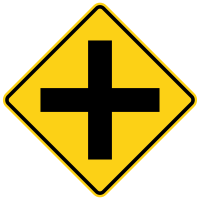
Show answer and explanation
Answer: A crossroad ahead: watch for cross traffic
A cross road is ahead: slow down and look carefully in all directions for cross traffic.
Report a problem
Question 11 of 20
How close to the nearest rail of a railroad crossing may you park?
Show answer and explanation
Answer: No closer than 50 feet
Do not park within 50 feet of the nearest rail of a railroad crossing.
Report a problem
Question 12 of 20
What should you do at this sign?
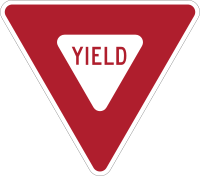
Show answer and explanation
Answer: Slow down, and stop if needed, to yield to traffic on the other road
A yield sign means your road joins another: slow down or stop to give the right-of-way to vehicles, pedestrians and bicycles.
Report a problem
Question 13 of 20
What does this sign tell you?
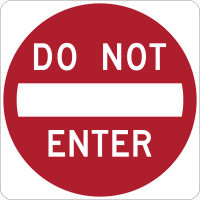
Show answer and explanation
Answer: Do not enter: traffic on that road comes toward you
The road ahead carries one-way traffic in the opposite direction; entering would put you into oncoming traffic.
Report a problem
Question 14 of 20
About how far ahead of an exit are exit signs usually placed?
Show answer and explanation
Answer: At least 1,000 yards
Exit signs are usually at least 1,000 yards before the exit; move into the proper lane well in advance.
Report a problem
Question 15 of 20
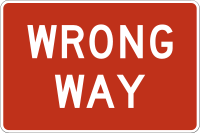
You see this sign facing you. What does it mean?
Show answer and explanation
Answer: You are driving the wrong way on a one-way street
WRONG WAY facing you means you are going directly against the flow of traffic; get out of the way safely and turn around.
Report a problem
Question 16 of 20
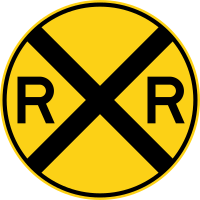
What does this round sign mean?
Show answer and explanation
Answer: A railroad crossing is a few hundred feet ahead: slow down and be ready to stop
You are within a few hundred feet of a railroad crossing; if a train is coming, stop. Never try to beat a train.
Report a problem
Question 17 of 20
On a multi-lane highway, which lane should you use if you drive slower than the normal flow?
Show answer and explanation
Answer: The right lane
Use the right lane at or below the normal flow; the middle or left lane is for faster traffic and passing.
Report a problem
Question 18 of 20
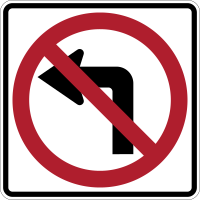
What does this sign mean?
Show answer and explanation
Answer: No left turn at this intersection
A left-turn arrow crossed by a red slash means left turns are prohibited where the sign is posted.
Report a problem
Question 19 of 20
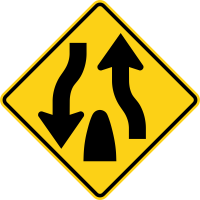
What does this sign mean?
Show answer and explanation
Answer: The divided highway ends: two-way traffic begins
The divided highway ends ahead; be careful where two-way traffic begins again.
Report a problem
Question 20 of 20
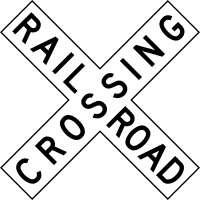
What does this sign mark?
Show answer and explanation
Answer: The location of the train tracks at a crossing
The crossbuck marks the tracks; if there is more than one track, it shows how many. Slow down, look, listen and be ready to yield.
Report a problem
Your score
0%0 / 20
Review the explanations of the questions you missed.
More practice tests
Full exam and road signs
Practice tests
- Practice Test 120 questions
- Practice Test 220 questions
- Practice Test 320 questions
- Practice Test 520 questions
- Practice Test 620 questions
- Practice Test 720 questions
- Practice Test 820 questions
- Practice Test 920 questions
- Practice Test 1020 questions
- Practice Test 1120 questions
- Practice Test 1220 questions
Tests by topic
- Alcohol and Drugs17 questions
- Traffic Signals and Signs20 questions
- Right-of-Way Rules19 questions
- Getting Your License20 questions
- Your Car, Signals and Headlights16 questions
- Lanes, Turns and Passing19 questions
- Parking Rules14 questions
- Sharing the Road19 questions
- Speed Limits and Other Laws15 questions
- Safe Driving16 questions
- Weather, Breakdowns and Emergencies14 questions
- Insurance and Collisions17 questions