Texas Permit Practice Test 10 (2026)
20 questions. Tap an answer to check it.
From the official handbook, Revised January 2026, Sections 4, 5, 6, 7, 8, 9, 14 · Checked Oct 2026 · Not affiliated with the DPS. Texas Driver Handbook (DL-7)
Question 1 of 20
On a work-zone barricade, the diagonal stripes slope down to the right. Which way should you go?
Show answer and explanation
Answer: Bear to the right
The stripes point the way: sloping down to the right means pass to the right; down to the left, pass to the left.
Report a problem
Question 2 of 20
Where should you slow down when leaving a highway?
Show answer and explanation
Answer: On the exit ramp
Keep your speed in the main lanes and slow down on the exit ramp, so you are within the new limit when you leave it.
Report a problem
Question 3 of 20
At a T-intersection, you are on the street that ends. What must you do?
Show answer and explanation
Answer: Stop and yield to vehicles on the through street
A driver on the street that ends at a T-intersection must stop and yield to traffic on the through street.
Report a problem
Question 4 of 20
About how long does the average driver take to think, react and start braking?
Show answer and explanation
Answer: 1½ seconds
The average person needs about 1½ seconds to think, react and apply the brakes, before the car even starts to slow.
Report a problem
Question 5 of 20
A 15-year-old passenger rides without a safety belt. Who can be fined?
Show answer and explanation
Answer: The driver
The driver is fined for passengers under 17 without a safety belt; passengers 15 and older can also be cited themselves.
Report a problem
Question 6 of 20
What does this sign require?
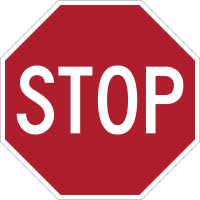
Show answer and explanation
Answer: Come to a complete stop, yield, then proceed carefully
Stop before the crosswalk, intersection or sign. Slowing down is not enough.
Report a problem
Question 7 of 20
How may you use a center left-turn lane?
Show answer and explanation
Answer: Only to turn left, entering it where you have time to slow down
The center lane is only for left turns, never for passing or through traffic.
Report a problem
Question 8 of 20
You are leaving a driveway or alley to enter a street. What must you do?
Show answer and explanation
Answer: Stop before the sidewalk and yield to all vehicles and pedestrians
From a private road, alley, building or driveway, stop before the sidewalk and yield to all vehicles and pedestrians.
Report a problem
Question 9 of 20
On dry pavement with good brakes, about how many feet does a car need to stop from 60 mph, including reaction distance?
Show answer and explanation
Answer: About 303 feet
The handbook table gives about 303 feet to stop from 60 mph, and 387 feet from 70 mph.
Report a problem
Question 10 of 20
How much greater is your chance of being killed if you are thrown from your car?
Show answer and explanation
Answer: Five times greater
Safety belts keep you from being thrown from the car, where your chance of death is five times greater, and help you keep control.
Report a problem
Question 11 of 20
What does a red X on a lane-use control signal over your lane mean?
Show answer and explanation
Answer: Do not drive in that lane
A red X means do not use the lane; a steady yellow X means prepare to leave it; a green arrow means you may use it.
Report a problem
Question 12 of 20
On a road with more than one lane in your direction, what is the farthest left lane for?
Show answer and explanation
Answer: Passing
Slower traffic should use a lane other than the farthest left lane, which is for passing only.
Report a problem
Question 13 of 20
You are turning left at an intersection. To whom must you yield?
Show answer and explanation
Answer: Vehicles coming straight through from the other direction
When turning left, yield to oncoming vehicles going straight through.
Report a problem
Question 14 of 20
In a multi-lane roundabout, what should you avoid?
Show answer and explanation
Answer: Changing lanes inside the circle
Pick the right entry lane from the advance sign and do not change lanes while in the circle.
Report a problem
Question 15 of 20
How close to a stop sign, yield sign or flashing signal at the side of the road may you park on the approach?
Show answer and explanation
Answer: No closer than 30 feet
Do not park within 30 feet on the approach to a flashing signal, stop sign, yield sign or traffic signal at the roadside.
Report a problem
Question 16 of 20
When must you use your headlights in Texas?
Show answer and explanation
Answer: From 30 minutes after sunset to 30 minutes before sunrise, and when you cannot see 1,000 feet ahead
Headlights are required from 30 minutes after sunset to 30 minutes before sunrise, or whenever people or vehicles cannot be seen clearly at 1,000 feet.
Report a problem
Question 17 of 20
How close to the driveway entrance of a fire station may you park on the same side of the street?
Show answer and explanation
Answer: No closer than 20 feet
Do not park within 20 feet of a fire station driveway, or within 75 feet of it on the opposite side of the street.
Report a problem
Question 18 of 20
Why should you make sure your signal lights work properly?
Show answer and explanation
Answer: Hand signals are hard to see when it is not daylight
Hand and arm signals are legal but difficult to see outside daylight hours, so keep your signal lights working.
Report a problem
Question 19 of 20
You are following another vehicle at night. Within what distance must you use low beams?
Show answer and explanation
Answer: 300 feet
Dim your headlights when you are within 300 feet behind another vehicle.
Report a problem
Question 20 of 20
When must you switch to low beams for an oncoming vehicle?
Show answer and explanation
Answer: Within 500 feet of it
Use low beams within 500 feet of an oncoming vehicle and within 300 feet when following another vehicle.
Report a problem
Your score
0%0 / 20
Review the explanations of the questions you missed.
More practice tests
Full exam and road signs
Practice tests
Tests by topic
- Alcohol and Drugs17 questions
- Traffic Signals and Signs20 questions
- Right-of-Way Rules19 questions
- Getting Your License20 questions
- Your Car, Signals and Headlights16 questions
- Lanes, Turns and Passing19 questions
- Parking Rules14 questions
- Sharing the Road19 questions
- Speed Limits and Other Laws15 questions
- Safe Driving16 questions
- Weather, Breakdowns and Emergencies14 questions
- Insurance and Collisions17 questions