New Jersey Permit Practice Test 4 (2026)
20 questions. Tap an answer to check it.
From the official handbook, 2026, Sections 3, 4, 5, 11 · Checked Oct 2026 · Not affiliated with the MVC. New Jersey Driver Manual
Question 1 of 20
What does this sign mean?
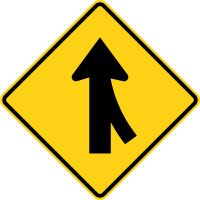
Show answer and explanation
Answer: Traffic from another lane will merge into yours ahead
Watch for vehicles merging into your lane from the side and adjust your speed.
Report a problem
Question 2 of 20
In a traffic circle with no signs, when in doubt about the right-of-way, who yields?
Show answer and explanation
Answer: The vehicle on the left yields to the one on the right
New Jersey has no set traffic-circle rule; when in doubt, use the uncontrolled-intersection rule: left yields to right.
Report a problem
Question 3 of 20
How can you report an aggressive driver from a cell phone in New Jersey?
Show answer and explanation
Answer: Call #77
Report aggressive drivers at (888) SAF-ROAD or #77 from a cell phone, preferably after pulling over.
Report a problem
Question 4 of 20
Which foot should you use for the brake and gas pedals?
Show answer and explanation
Answer: The right foot for both
Use your right foot for both the brake and the gas; with a manual transmission the left foot is for the clutch.
Report a problem
Question 5 of 20
With good brakes, within what distance should you be able to stop at 20 mph?
Show answer and explanation
Answer: 25 feet
You should be able to stop within 25 feet at 20 mph; you can test it in an empty parking lot.
Report a problem
Question 6 of 20
What does this sign warn you about?
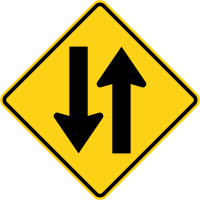
Show answer and explanation
Answer: Two-way traffic ahead: oncoming vehicles share the road
The road ahead carries traffic in both directions; stay to the right.
Report a problem
Question 7 of 20
You are coming out of a private driveway. Who has the right-of-way?
Show answer and explanation
Answer: All traffic on the main road
Drivers coming from a private road or driveway must yield to all traffic on the main road.
Report a problem
Question 8 of 20
How far does a car travel each second at 60 mph?
Show answer and explanation
Answer: 88 feet
At 60 mph you cover 88 feet every second, so even a short glance away means a long blind distance.
Report a problem
Question 9 of 20
How should you brake in a car with anti-lock brakes (ABS)?
Show answer and explanation
Answer: Press firmly and steadily; do not pump or jerk the wheel
With ABS keep firm, steady pressure; pumping the brakes or jerking the wheel can make you lose control.
Report a problem
Question 10 of 20
How should you adjust your speed at night?
Show answer and explanation
Answer: Slow down so you can stop within the range of your headlights
At night vision is reduced; drive within the range of your headlights so you can stop in the distance you can see.
Report a problem
Question 11 of 20
At about what speed can tires start to hydroplane on wet roads?
Show answer and explanation
Answer: About 35 mph
Hydroplaning can begin around 35 mph; above 55 mph tires may leave the road surface completely.
Report a problem
Question 12 of 20
What does this sign mean?
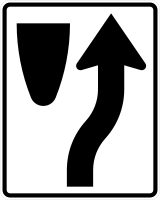
Show answer and explanation
Answer: Keep to the right of the divider or island
KEEP RIGHT means pass to the right of the median, island or obstruction.
Report a problem
Question 13 of 20
In a heavy rainstorm on a multi-lane highway, where should you try to drive?
Show answer and explanation
Answer: On the highest point of the road, such as the center lane
Water collects at the edges; driving on the highest part of the road, like the center lane, lowers the risk of hydroplaning.
Report a problem
Question 14 of 20
What does this sign tell you?
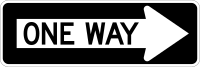
Show answer and explanation
Answer: Traffic moves only in the direction of the arrow
ONE WAY means drive only in the direction of the arrow.
Report a problem
Question 15 of 20
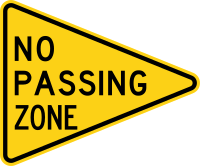
What does this pennant-shaped sign mean?
Show answer and explanation
Answer: No passing zone
The yellow pennant on the left side of the road marks the start of a no-passing zone.
Report a problem
Question 16 of 20
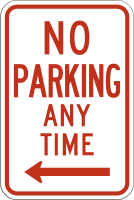
What does this sign mean?
Show answer and explanation
Answer: Parking is not allowed at any time
NO PARKING ANY TIME prohibits parking there at every hour, every day.
Report a problem
Question 17 of 20
You miss your highway exit. What should you do?
Show answer and explanation
Answer: Go on to the next exit
If you miss an exit, go on to the next one; never back up on a ramp or deceleration lane.
Report a problem
Question 18 of 20
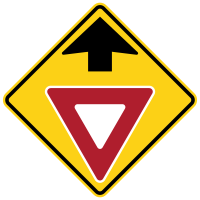
What does this sign tell you?
Show answer and explanation
Answer: A yield sign is ahead: slow down and be ready to stop
A yield sign is ahead; slow down so you can yield or stop if needed.
Report a problem
Question 19 of 20
In a weave lane, who must yield?
Show answer and explanation
Answer: The driver entering from the ramp yields to the driver leaving the expressway
A weave lane is both an entrance and an exit; drivers entering must yield to drivers leaving.
Report a problem
Question 20 of 20
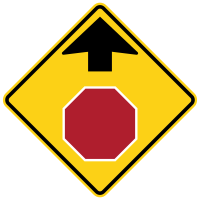
What does this sign tell you?
Show answer and explanation
Answer: A stop sign is ahead: be ready to stop
This warning sign tells you a STOP sign is coming up, often where it is hard to see.
Report a problem
Your score
0%0 / 20
Review the explanations of the questions you missed.
More practice tests
Full exam and road signs
Practice tests
Tests by topic
- Alcohol and Drugs13 questions
- Traffic Signals and Signs17 questions
- Right-of-Way Rules14 questions
- Getting Your License18 questions
- Your Car, Signals and Headlights16 questions
- Lanes, Turns and Passing13 questions
- Parking Rules10 questions
- Sharing the Road18 questions
- Speed Limits and Other Laws20 questions
- Safe Driving14 questions
- Weather, Breakdowns and Emergencies16 questions
- Insurance and Collisions11 questions